


Rights activists yesterday slammed police over their “show of concern” to farmers in Miaoli and Hsinchu Counties prior to a demonstration against land expropriation scheduled to take place in Taipei today, calling it a violation of people’s freedom of expression.
Members of self-help organizations in both Dapu Borough (大埔), Jhunan Township (竹南), Miaoli County and the Erchongpu (二重埔) community in Jhudong Township (竹東), Hsinchu County, told the Taipei Times yesterday that local police officers inquired whether members of the organizations would take part in a demonstration against forced land expropriation organized by residents of Leshan Village, (樂善) in Taoyuan County’s Gueishan Township (龜山), scheduled to be held in Taipei today, and asked them to report to local police stations if they plan to participate.
Dapu and Erchongpu are both farming villages facing land expropriations to make room for science park projects, while plots of land in Leshan Village are to be turned into an airport express train station, an industrial zone and social housing complexes.
“We’re not planning to take part, but even if we’re going to, it’s not our business to talk to police because we’re not the event organizer,” Dapu Self-Help Organization spokeswoman Yeh Hsiu-tao (葉秀桃) said. “This is not something that should happen in a democratic country.”
Yeh said that this was not the first time that police had interfered had with them. During the peak of their protest activities last year, she said, “the police kept an eye on the our organization’s leader almost 24 hours a day.”
Liu Ching-chang (劉慶昌), a member of the Erchongpu Self-Help Organization, and head of the Alliance for the Defense of Farming Villages, said that local police have also contacted her to “show their concern” about whether the organization would participate in the rally today.
“I think this is a violation of our rights. It’s our right to speak out for ourselves and to defend our properties,” Liu said. “Everything we’re doing is legal and they’re showing too much ‘concern’ for us.”
“But of course, we’re used to it already,” he added.
Taiwan Association for Human Rights secretary-general Tsai Chin-hsun (蔡季勳) said such an act by the police is “unacceptable in a democracy.”
“Monitoring the people before they even get on the street is very inappropriate, and is harassment,” Tsai said. “We have become used to such monitoring, but many other people would feel threatened and scared if they get phone calls from the police prior to taking part in demonstrations, and would then probably just decide not to do so.”
“If that happens, it’s repression of the freedom of expression,” she added.
On the other hand, a police officer in charge of maintaining order and security during demonstrations in Taipei, who wished to remain anonymous, told the Taipei Times that they would always ask for information on rallies from organizers because they needed to know what kind of situation they would face.
“For example, we would need to know how many people would be there, so we could plan traffic control measure,” the officer said. “We also need to know the necessary amount of manpower we have to deploy to keep demonstrations proceeding smoothly.”
However, the officer admitted that there are some police precincts overreacting to demonstrations, “and may do things that violate citizens’ legal rights to rallies and assemblies.”

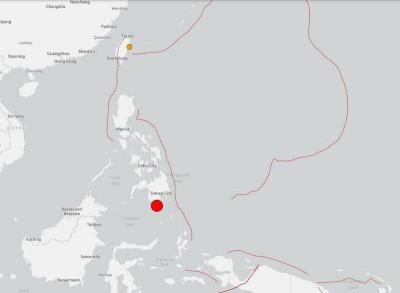
A magnitude 7.8 earthquake struck off the southern coast of Mindanao in the Philippines at 7:38am today, prompting the US Tsunami Warning System to issue an alert for neighboring countries, including Taiwan. The system issued a purple alert indicating a "tsunami threat." The potential threat zone includes Taiwan, the Philippines, Papua New Guinea, Yap and Palau. There were no immediate reports of major damage in the Philippines or Indonesia. The quake struck at a depth of 10km, said the German Research Centre for Geosciences, which had earlier pegged the earthquake at magnitude 8.2. Phivolcs, the Philippine agency, said the quake was magnitude 7 and

RESILIENCE: Taiwan plays a key role in semiconductors, energy, information infrastructure and advanced manufacturing, AIT Director Raymond Greene said Taiwan’s continued investment in deterrence and resilience remains vital, especially in uncrewed systems and other emerging technologies, American Institute in Taiwan (AIT) Director Raymond Greene said yesterday. Greene made the remarks at the annual National Strategic Summit on Supply Chain Resilience held by the Research Institute for Democracy, Society and Emerging Technology (DSET), a government-backed think tank. As Taiwan last year became the US’ fourth-largest trading partner and supply chain security is becoming more important, cooperation in emerging technologies continues to deepen between the two countries, he said. The US is committed to accelerating innovation, building key infrastructure, strengthening cooperation

The National Chungshan Institute of Science and Technology yesterday showcased its locally developed variants of the Vision 60 robotic patrol dog, which it plans to deploy on the nation’s outlying territories in the South China Sea. The variants were produced under the Joint Lab project — created by the institute and domestic companies — and assembled with domestically produced motors, lenses and artificial intelligence (AI) systems alongside licensed tech from the US, Missile and Rocket Systems Research Division deputy director Jen Kuo-kang (任國光) told the media event at a military base in Taipei’s Dazhi (大直) area. Taiwan has built up its strengths

RIGHT DIRECTION: Taiwan’s efforts to prevent forced labor include a proposal to ‘fully prohibit’ employers from withholding workers’ documents, an official said Taiwan is to establish a mechanism to restrict imports of goods linked to forced labor, the Executive Yuan said yesterday, after the US proposed imposing additional tariffs on Taiwanese goods over labor concerns. “The Ministry of Labor and the Ministry of Economic Affairs are to establish an interministerial review procedure,” Executive Yuan spokesperson Michelle Lee (李慧芝) said at a news briefing in Taipei. “The government is to use the Foreign Trade Act [貿易法] as the legal basis to restrict imports of goods produced with forced labor” and bring its supply chain governance more in line with international standards on human rights, resilience


 RSS
RSS